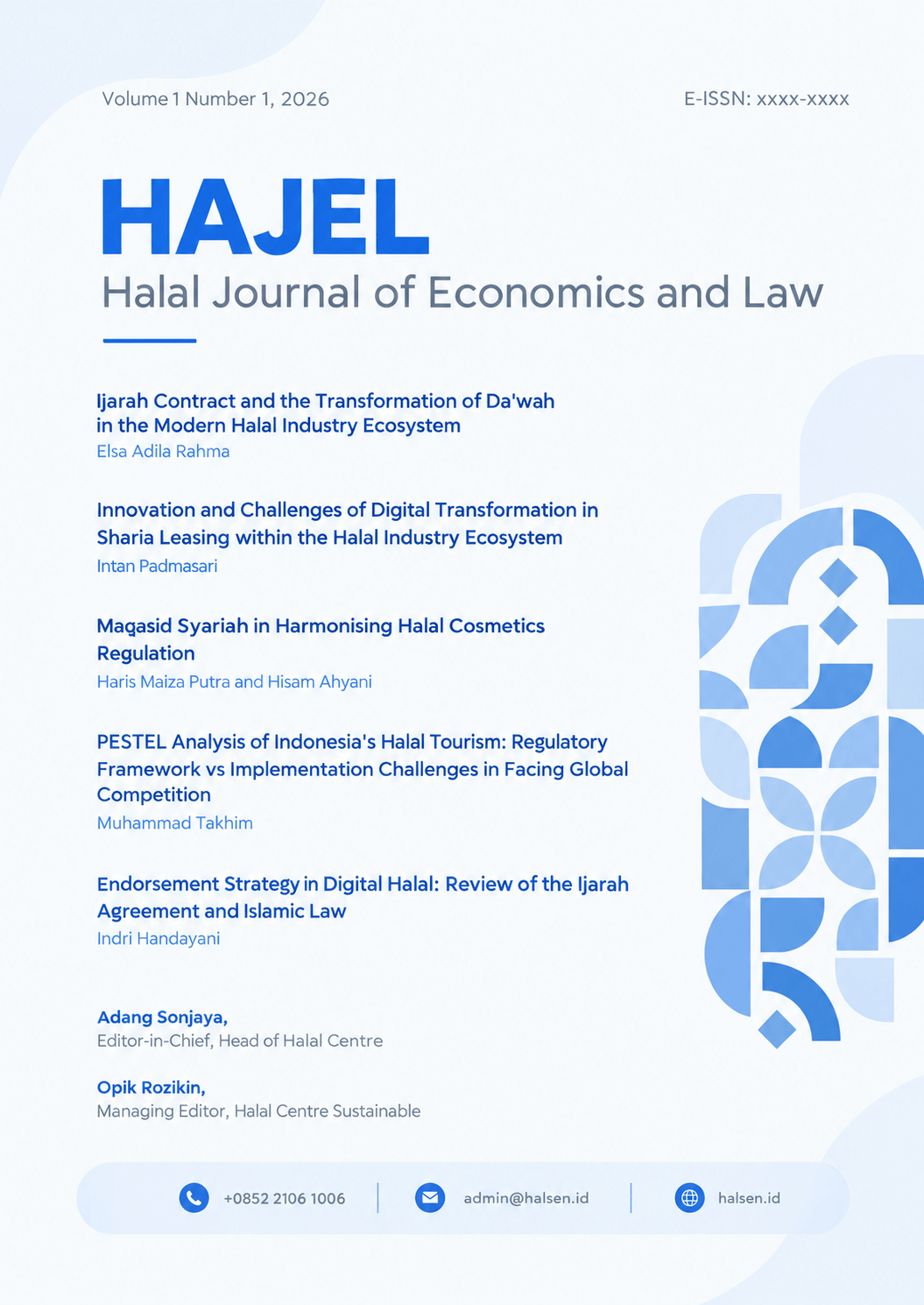
Halal Journal of Economics and Law (HAJEL)
Halal Journal of Economics and Law (HAJEL) (Online ISSSN: XXXX-XXXX) is a peer-reviewed academic journal published binually by Halal Center Sustainability (HALSEN) in collaboration with POSDHESI (Perkumpulan Dosen dan Program Studi Hukum Ekonomi Syariah Indonesia) that serves as an interdisciplinary platform for advancing scholarship in Islamic economics, the halal industry, and Islamic jurisprudence (fiqh). The journal responds to the pressing need for scholarly literature that bridges three domains of inquiry often treated in isolation—Islamic economics and finance, halal supply chain management, and Islamic legal thought—despite their deep interconnection within the contemporary halal ecosystem.
The rapid expansion of the global halal industry, no longer confined to the food sector but extending into Islamic finance, tourism, pharmaceuticals, cosmetics, and the broader halal lifestyle, demands rigorous, evidence-based academic inquiry. At the same time, evolving sharia compliance dynamics and the growing need for credible halal auditing mechanisms require a robust foundation in fiqh muamalah (Islamic commercial jurisprudence), coupled with a positive legal framework that can adapt to the complexities of modern economic transactions. HAJEL is positioned to address this gap by providing a publication space that brings together normative-doctrinal perspectives in Islamic law with empirical and sociological approaches to the study of economics and the halal industry.
Scope of the Journal
The journal welcomes contributions on, but not limited to, the following thematic areas:
- Islamic Economics and Finance — theoretical and empirical studies on sharia-based financial systems, Islamic banking, and sharia-compliant investment instruments.
- Halal Supply Chain and Management — analyses of halal assurance systems, logistics, and governance within halal industry supply chains.
- Sharia Compliance and Auditing — the development of sharia compliance audit methodologies and oversight mechanisms within Islamic financial institutions and the halal industry more broadly.
- Islamic Jurisprudence (Fiqh Muamalah) — in-depth examinations of Islamic legal doctrine as applied to contemporary economic transactions.
- Comparative Legal Studies in Economics — comparative analyses of economic legal systems, whether between Islamic law and national positive law or across jurisdictions.
- Halal Tourism and Lifestyle — studies on the development of Muslim-friendly tourism and emerging trends in halal lifestyle consumption.
As a scholarly publishing platform, HAJEL aims to serve as a key reference point for academics, researchers, policymakers, and practitioners engaged in formulating both theoretical propositions and practical solutions to contemporary challenges in Islamic economics and law. Its multidisciplinary orientation—integrating doctrinal analysis of Islamic law, the sociology of economic law, and policy studies—renders the journal relevant not only to scholars of law and sharia, but also to industry practitioners and regulators concerned with the governance of a halal ecosystem grounded in justice ('adalah) and the objectives of Islamic law (maqashid al-sharia).